This past week the web standards organization Khronos Group (the folks responsible for management of the OpenGL standards) announced a partnership with Mozilla that will aim to create a new open standard for ‘accelerated 3D on the web’.
The announcement generated quite a bit of buzz and commentary in the online graphics community. John Dowdell of Adobe wrote a highly critical blog post on the announcement titled "Standards for thee, but not for me". The crux of John's message seems to be that there are already open standards for Web3D (VRML, X3D) and several open and functional browser-based rendering engines. After reading this post, I could see John's point. What's a standard worth if it can be so easily disregarded? But further investigation into matter showed that what Mozilla is proposing is quite different from these existing standards.
While VRML and X3D provide a common vocabulary and standard schema for structuring Web3D data, the Khronos/Mozilla group will work to standardize the way in which this type of data is delivered via the Web. The current leading idea seems to be an interface based on JavaScript (plugin-less!) that would allow direct access to OpenGL rendering functions. This means that VRML and X3D would remain a viable way to organize and store your data and the new standard would provide a common method for the rendering side of the equation.
A CNet article provides a little more info and points out that Adobe is currently looking at incorporating 3D into their Flash-plugin as well....coincidence?
In the end, I think this partnership sounds like it has great promise. It remains to be seen if and when and results would be seen, but the ideas are solid. N Formation Design has long held that a plugin-less content delivery system is the only way to provide viable Web3D. A common, open, hardware-accelerated standard for this would be huge. We'll hope for the best!

3/29/09
3D Captcha
Most everyone these days who has participated any sort of web-service is familiar with the Captcha. It's the (usually) annoying little set of disfigured letters or words that you must decode and type into a box to assure that system that you are, indeed, a human being. Weeding out traffic from hackers and bots is a necessity so that the providers of these automated services can dedicate their time and resources to serving real users. While the current common Captcha system has helped in this respect, it has put an unnecessary additional load on users (Does it ever work right the first time?) and is not foolproof.
The conceptualization and implementation of a new 3D Captcha system promises both an easier and more reliable solution as well as highlighting a new niche for 3D on the web. Instead of identifying words or letters, users would have to choose images that match with a randomly generated view of a 3D object.
From the CNET article:
The system relies on the human brain's ability to easily identify different views of a complex 3D object as being the same object. An algorithm can be created to automatically process a text-based Captcha image and try to translate the symbols found into the finite set of available letter, number, and symbol characters. The more disfigured the symobls, the harder for the algorithm to process, but also harder for the human to process! This 3D solution greatly simplifies the ordeal for users while exponentially increasing the difficulty of automating a hack.
What a creative and elegant solution to a complex problem! Three cheers for evolution! :)
The conceptualization and implementation of a new 3D Captcha system promises both an easier and more reliable solution as well as highlighting a new niche for 3D on the web. Instead of identifying words or letters, users would have to choose images that match with a randomly generated view of a 3D object.
From the CNET article:
The challenge is a 3D image of an animal, say of a rabbit's face. The list of answers would display different common animals from different angles, including a photo of the rabbit, this time of its side. Only a human brain would be able to quickly see that the challenge image and the second image on the answer list are of the same animal. Now you just need to click on the correct second image to pass the challenge.
The system relies on the human brain's ability to easily identify different views of a complex 3D object as being the same object. An algorithm can be created to automatically process a text-based Captcha image and try to translate the symbols found into the finite set of available letter, number, and symbol characters. The more disfigured the symobls, the harder for the algorithm to process, but also harder for the human to process! This 3D solution greatly simplifies the ordeal for users while exponentially increasing the difficulty of automating a hack.
What a creative and elegant solution to a complex problem! Three cheers for evolution! :)
2/1/09
Make3D - From 2D to 3D in an Instant
Automated generation of 3D content is an interesting and noteworthy problem that seems to be getting more and more attention lately. With the boom of custom user-driven 3D content both online (virtual worlds, 3D chats, etc.) and off (video games) there is an increasing demand for better, cheaper, and more personalized models. Automating model creation, or at least an initial base model, would allow content producers to work faster and in higher volume without sacrificing quality.
Along with our previous reviews of PhotoSynth and VideoTrace we will now add Make3D as a promising example of automated 3D.
Make3D relies on a complex algorithm created by researchers at Stanford University. As users upload images to the Make3D site, algorithm increases it's efficacy by 'learning' more about constructing 3D scenes based on the new 2D information it has. From the site:
Check out the gallery for some very cool interactive examples of Make3D's output. Though the site has recently suspended automated new user registration, a note on the site indicates that you can still get access by emailing the webmaster.
As a bonus for researchers and ambitious tinkerers the code is available for download as well!
Along with our previous reviews of PhotoSynth and VideoTrace we will now add Make3D as a promising example of automated 3D.
Make3D relies on a complex algorithm created by researchers at Stanford University. As users upload images to the Make3D site, algorithm increases it's efficacy by 'learning' more about constructing 3D scenes based on the new 2D information it has. From the site:
The algorithm models both image depth cues as well as the relationships between different parts of the image. Other than assuming that the environment is made up of a number of small planes, our model makes no explicit assumptions about the structure of the scene; this enables the algorithm to generalize well to scenes that were not seen before in the training set.
Check out the gallery for some very cool interactive examples of Make3D's output. Though the site has recently suspended automated new user registration, a note on the site indicates that you can still get access by emailing the webmaster.
As a bonus for researchers and ambitious tinkerers the code is available for download as well!
1/15/09
Digital Preservation in China
The Bureau of Surveying and mapping in China has announced that they are nearly finished measuring and digitizing the last surviving portions of the Great Wall. The digital models are being created from detailed photographic mappings of nine provinces in the northern region of the country.
Furthermore, the traditionally Internet-unfriendly Chinese government will make the models available online.
This is a great example of the preservation benefits of 3D digitizing and modeling. Even though the wall is significantly degraded, future generations will be able to view and reproduce this "Wonder of the World" as it stands at this time.
Maybe Google can convince them to allow the inclusion of these models into their recent efforts to catalog history?
Furthermore, the traditionally Internet-unfriendly Chinese government will make the models available online.
This is a great example of the preservation benefits of 3D digitizing and modeling. Even though the wall is significantly degraded, future generations will be able to view and reproduce this "Wonder of the World" as it stands at this time.
Maybe Google can convince them to allow the inclusion of these models into their recent efforts to catalog history?
1/14/09
Project Launch: 3D Pendant Configurator

We are happy to announce the successful launch of our latest interactive web project, a 3d configurator and sales application for custom made pendants. Commisioned by Austin & Warburton Jewelers of Ann Arbor, MI, the application was launched at TheParentAndChild.com shortly before the busy holiday shopping season.
From the project page:
We designed a set of customized 3d configurators that independently focused on each of the detailed and unique pendants. Users can load one of the three pieces and configure it to their own specifications. Choices include pendant size and several metal types and colors. A wide cariety of gemstones can also be selected and placed in specific locations. Each configuration choice is updated instantly on the 3d model without a page reload.The application was fully integrated with the client's existing shopping cart system and provided a significant upgrade from their previous set of static 2D images. The previous month of heavy use has shown the application to be a great success as described in the message below from Craig Warburton, owner and manager of Austin & Warburton Jewelry:
"It is difficult to describe just how much the product configurator has meant to our online business. Cart abandonment has dropped by 50%, returns for selecting undersized birthstones has all but disappeared and sales have grown 50% faster than I ever imagined possible. The 3D format allows the user to see just how thick and heavy the item is, removing the "cheap and flimsy" fear so much online jewelry formats invoke. The service we received was world class in scope, depth and timing. The seamless integration into our shopping cart software is amazing. In one keystroke, the user can place as many as 10 items into the cart, and we gained control otherwise only provided by written warnings when you established "rules" for application of stone sizes and locations. I always felt our website was superior to many others in our product field, but the configurator you created is the new engine of sales and unmatched by anything in the marketplace. I will call on N Formation Design again and again. The value provided far exceeded my every expectation."
1/13/09
Googling the Future
For a great example of the benefits of 3d and virtual environments, take a look at the new addition to Google Earth recently reported in an article by a Bay Area ABC affiliate.
Google Earth has become a great tool for interactively viewing existing structures and topology, but the truly novel step comes in integrating future structures with the existing world. Google has done just that by adding models (provided by Caltrans) of the yet-to-be-completed Bay Bridge over the existing virtual San Francisco Bay.
From the article:
I hope this is not just an idle PR statement. Google Earth over time (Google History?) would be an amazing and unprecedented educational tool. The amount of data that could be incorporated is almost unfathomable. The movement of land masses, industrialization, perhaps even battle re-enactments. If anybody can do it, I believe it will be these guys. Fingers crossed!
Google Earth has become a great tool for interactively viewing existing structures and topology, but the truly novel step comes in integrating future structures with the existing world. Google has done just that by adding models (provided by Caltrans) of the yet-to-be-completed Bay Bridge over the existing virtual San Francisco Bay.
From the article:
Until now, Google Earth had a policy of showing only completed structures, for an accurate picture of the earth. But along with adding 3D images, Google has decided to go into the fourth dimension -- time. The bridge is the future, Ancient Rome is in the past.
"I would like to do more of the past, more of the future, to make Google Earth not just everywhere, but every when. A time travel machine for people to understand their heritage, and their future," said [Google CTO Michael] Jones.
I hope this is not just an idle PR statement. Google Earth over time (Google History?) would be an amazing and unprecedented educational tool. The amount of data that could be incorporated is almost unfathomable. The movement of land masses, industrialization, perhaps even battle re-enactments. If anybody can do it, I believe it will be these guys. Fingers crossed!
1/8/09
Desktop 3D Scanning
The RealView 3D company has announced a new desktop 3D scanner that will be unveiled at the recently opened CES 2009. It's great to see more competition in this market. Hopefully the prices of these systems will begin to come down! NextEngine seems to have the most popular 'low cost' version which still comes in at $2995 for the bare-bones package. Though we don't have one in house, I have seen demos of the NextEngine system and the quality is very good for the price. Unfortunately, there doesn't seem to be any price or quality info currently available for the RealView scanner. It will be interesting to compare the too once more details are released. A recent Wired article is already predicting a loss for RealView...
In the meantime, why not try out a do-it-yourself solution! The DAVID scanner requires only a handheld laser ( < $30 USD), a webcam (< $50 USD), and a license for the DAVID-laserscanner software (trial version - FREE, pro version, ~$275 USD). There are some demos and production videos on the site that are definitely worth checking out. Pretty amazing for the investment! If this sort of project is up your alley, why not add on a DIY 3D printer for a full-blown homemade prduction pipeline!
Though all this solutions will inevitably require some patching and smoothing by a 3D artist for production quality models, the increasing availability and accessibility of these machines will no doubt decrease the workload for developers and allow us to produce high-quality content faster and more cost-effectively.
In the meantime, why not try out a do-it-yourself solution! The DAVID scanner requires only a handheld laser ( < $30 USD), a webcam (< $50 USD), and a license for the DAVID-laserscanner software (trial version - FREE, pro version, ~$275 USD). There are some demos and production videos on the site that are definitely worth checking out. Pretty amazing for the investment! If this sort of project is up your alley, why not add on a DIY 3D printer for a full-blown homemade prduction pipeline!
Though all this solutions will inevitably require some patching and smoothing by a 3D artist for production quality models, the increasing availability and accessibility of these machines will no doubt decrease the workload for developers and allow us to produce high-quality content faster and more cost-effectively.
1/6/09
3D Nature! - Interactive Vizualization Hits the Big Time
Nature, the preeminent journal of scientific research, has boosted the credibility of interactive 3d for scientific visualization by publishing their first 3d interactive figure. The January 1st issue contains 3d figures of molecular clouds in a paper first-authored by Alyssa A. Goodman, astronomy professor at Harvard University.
Nature makes use of '3d PDF' technology which allows 3d applets to be embedded in PDF document pages, much like we currently embed them in traditional web pages. Try out the published models (and others) for yourself at this page on the site of Goodman's Initiative in Innovative Computing group. Note: You'll need Adobe Reader 8.1.2 or better to view and interact with the 3d modules.
Screenshot:

We won't pretend to comprehend exactly what is going on in this figure, but one thing we do know is 3d - and the fidelity of this model is fantastic. There a few awkward interaction elements that could be smoothed out, but nothing due to limitations of the technology. The most exciting about this publication for us is that the backing of Nature is sure to increase the exposure and enthusiasm for interactive 3d technologies. Many fields that already make use of 3d technologies to visualize data in their labs will greatly benefit from this expanded ability to communicate their findings to readers.
Anyone interested in using 3d PDF technology for their own work should contact us for more detail.
Nature makes use of '3d PDF' technology which allows 3d applets to be embedded in PDF document pages, much like we currently embed them in traditional web pages. Try out the published models (and others) for yourself at this page on the site of Goodman's Initiative in Innovative Computing group. Note: You'll need Adobe Reader 8.1.2 or better to view and interact with the 3d modules.
Screenshot:

We won't pretend to comprehend exactly what is going on in this figure, but one thing we do know is 3d - and the fidelity of this model is fantastic. There a few awkward interaction elements that could be smoothed out, but nothing due to limitations of the technology. The most exciting about this publication for us is that the backing of Nature is sure to increase the exposure and enthusiasm for interactive 3d technologies. Many fields that already make use of 3d technologies to visualize data in their labs will greatly benefit from this expanded ability to communicate their findings to readers.
Anyone interested in using 3d PDF technology for their own work should contact us for more detail.
1/5/09
3D Arlington - Leading the Way
A recent article in the Washington Post highlights efforts by Arlington County government to bring the region into the flourishing world of interactive 3d. Resident John Feather is volunteering his time to get these advanced technology initiatives off the ground and making sure they get the attention they deserve.
Much of the article is devoted to area presences in Second Life. Feather (avatar name: Theatre Magic) leads reporters and other interested parties on guided tours of some of these spaces, making sure to show the power and flexibility of the environment:
We need more people like John! It's great to see people in previously untapped areas of life getting the interest and enthusiasm for interactive 3d that us pros have been shouting about for years. I found the following note most interesting:
This sounds like a great idea that even non-techies can see the benefit of. Incorporating spatial data (buildings and locations) with other info (rent data, etc.) will allow people to explore data in a new and relevant way while helping them to answer important questions (where should I live?).
Keep it up John! We applaud your enthusiasm and hope that it inspires others. Let us know if there is anything we can do to help!
Much of the article is devoted to area presences in Second Life. Feather (avatar name: Theatre Magic) leads reporters and other interested parties on guided tours of some of these spaces, making sure to show the power and flexibility of the environment:
One recent evening, Theatre was shepherding a reporter toward the county's online office space for a tour when he sent a text message suggesting a detour. "Want to go swimming?" he wrote. He then teleported to a lake surrounded by Japanese maples and did a summersault from a cliff with an animated Buddha nearby. It was a long way from the Arlington office, but what better place to ponder the future of government?
We need more people like John! It's great to see people in previously untapped areas of life getting the interest and enthusiasm for interactive 3d that us pros have been shouting about for years. I found the following note most interesting:
In November, he started working on a 3D map of Arlington's major buildings. Touching images on the map calls up Web pages about them, and he and his colleagues want to add real-time rent data and detailed visuals from architects and developers so that "when you click on that building, you go in the door."
This sounds like a great idea that even non-techies can see the benefit of. Incorporating spatial data (buildings and locations) with other info (rent data, etc.) will allow people to explore data in a new and relevant way while helping them to answer important questions (where should I live?).
Keep it up John! We applaud your enthusiasm and hope that it inspires others. Let us know if there is anything we can do to help!
1/2/09
Ringing in the New Year
N Formation Design had a great 2008 with many exciting interactive 3d projects. We look forward to new adventures in the coming year and hope for continued adoption of interactive 3d technologies.
Stay tuned to the N Formation Design Blog for more (and hopefully more frequent!) news, tips, and technology reviews in the coming year.
Happy New Year and best wishes for business in 2009!
Stay tuned to the N Formation Design Blog for more (and hopefully more frequent!) news, tips, and technology reviews in the coming year.
Happy New Year and best wishes for business in 2009!
10/13/08
EmergingTech: ILoveSketch
ILoveSketch is a very cool application recently announced by the Dynamic Graphics Project (DGP) lab at the University of Toronto. In short, it makes sketching in 3D as intuitive as I have ever seen it. Anyone who has ever tried 3D modeling, especially an organic object, knows that the process is far from straight-forward. Sketches are usually used only as 2d reference points that have to be viewed in a single viewport.
Though ILoveSketch doesn't translate sketches directly into models, it's easy to see how helpful it could be in the process. And who knows, maybe the DGP will use this great app as a starting point for something bigger? Take a look at a video of the software in use and see for yourself!
From the site - ILoveSketch is:
"A 3D curve sketching system that captures some of the affordances of pen and paper for professional designers, allowing them to iterate directly on concept 3D curve models. The system coherently integrates existing techniques of sketch-based interaction with a number of novel and enhanced features. Novel contributions of the system include automatic view rotation to improve curve sketchability, an axis widget for sketch surface selection, and implicitly inferred changes between sketching techniques. We also improve on a number of existing ideas such as a virtual sketchbook, simplified 2D and 3D view navigation, multi-stroke NURBS curve creation, and a cohesive gesture vocabulary."
Though ILoveSketch doesn't translate sketches directly into models, it's easy to see how helpful it could be in the process. And who knows, maybe the DGP will use this great app as a starting point for something bigger? Take a look at a video of the software in use and see for yourself!
From the site - ILoveSketch is:
"A 3D curve sketching system that captures some of the affordances of pen and paper for professional designers, allowing them to iterate directly on concept 3D curve models. The system coherently integrates existing techniques of sketch-based interaction with a number of novel and enhanced features. Novel contributions of the system include automatic view rotation to improve curve sketchability, an axis widget for sketch surface selection, and implicitly inferred changes between sketching techniques. We also improve on a number of existing ideas such as a virtual sketchbook, simplified 2D and 3D view navigation, multi-stroke NURBS curve creation, and a cohesive gesture vocabulary."
9/24/08
Review: ExitReality
I recently came across another newcomer to the web-based virtual worlds market: ExitReality.
At face value, ExitReality functions similarly to all of the others out there (SL, Vivaty, Lively, IMVU, etc.). You register (free), login, and get a customizable avatar dropped into a social 'lounge' area where other users also congregate. When I first tried the Beta environment out, there were about 10 other users. Pretty small, but they seem to be fairly new and still growing.
 The unique thing about ExitReality is that it is based around the idea of navigating an actual 3d web. It's a concept that has been tried many times before, but never really caught on. In the 'ExitReality Plaza' the commercial aspects of this are pretty in your face. Each major building or structure in the environment is associated with some sort of business interest. There's a Carl's Jr, Wall Street Journal, and ESPN buildings, a Match.com ice cream truck (?) and many others. And as far as I can tell, these commercial interests are all just facades. I would expect to be able to go into the buildings and find related content, but the only further action is to click on their signs and be taken to their regular 2d site.
It's an interesting idea, but I still don't see it gaining mass market appeal. So far, it seems to just be a 3d chat with a whole lot of advertisements. There's just not a whole lot to do. The one advantage this site has over others is load time. It was definitely quicker than the others I've reviewed, but other important aspects - navigation, visual quality, content - all seemed to be lacking. If they mature in at least one of these areas, I'd consider them a contender due to their novelty but right now, they have a ways to go.
 The other interesting aspect of this site is their claim to 'View any website in 3d'. I tried our site and got a pretty sad result. The algorithm they are using seems to just grab the graphics from your screen and paste them on various objects in an environment. They also seem to incorporate the site color scheme into the overall asthetic. The '3d' nformationdesign.com turned out to be one big wall with a screen shot of the homepage and then a 'field' of linked graphics that looked like flags on poles. It was pretty disappointing. I think this 'view any page in 3d' concept is probably their best selling point, but the algorithm needs some major improvements. Maybe some simple image processing to guess at what some of the pictures are, so they can be turned into actual 3d representations? How about doors or passages to take you to other rooms (pages) of the site instead of these link 'flags'? There are a lot of options here.
I'm glad to see more businesses take a stab at this sort of thing, but I think the market is getting to the point where the application needs to be a little more mature to catch on.

Did I miss something? Let me know.
At face value, ExitReality functions similarly to all of the others out there (SL, Vivaty, Lively, IMVU, etc.). You register (free), login, and get a customizable avatar dropped into a social 'lounge' area where other users also congregate. When I first tried the Beta environment out, there were about 10 other users. Pretty small, but they seem to be fairly new and still growing.
 The unique thing about ExitReality is that it is based around the idea of navigating an actual 3d web. It's a concept that has been tried many times before, but never really caught on. In the 'ExitReality Plaza' the commercial aspects of this are pretty in your face. Each major building or structure in the environment is associated with some sort of business interest. There's a Carl's Jr, Wall Street Journal, and ESPN buildings, a Match.com ice cream truck (?) and many others. And as far as I can tell, these commercial interests are all just facades. I would expect to be able to go into the buildings and find related content, but the only further action is to click on their signs and be taken to their regular 2d site.
It's an interesting idea, but I still don't see it gaining mass market appeal. So far, it seems to just be a 3d chat with a whole lot of advertisements. There's just not a whole lot to do. The one advantage this site has over others is load time. It was definitely quicker than the others I've reviewed, but other important aspects - navigation, visual quality, content - all seemed to be lacking. If they mature in at least one of these areas, I'd consider them a contender due to their novelty but right now, they have a ways to go.
 The other interesting aspect of this site is their claim to 'View any website in 3d'. I tried our site and got a pretty sad result. The algorithm they are using seems to just grab the graphics from your screen and paste them on various objects in an environment. They also seem to incorporate the site color scheme into the overall asthetic. The '3d' nformationdesign.com turned out to be one big wall with a screen shot of the homepage and then a 'field' of linked graphics that looked like flags on poles. It was pretty disappointing. I think this 'view any page in 3d' concept is probably their best selling point, but the algorithm needs some major improvements. Maybe some simple image processing to guess at what some of the pictures are, so they can be turned into actual 3d representations? How about doors or passages to take you to other rooms (pages) of the site instead of these link 'flags'? There are a lot of options here.
I'm glad to see more businesses take a stab at this sort of thing, but I think the market is getting to the point where the application needs to be a little more mature to catch on.

Did I miss something? Let me know.
9/16/08
Ford Lake Data Visualization
N Formation Design is happy to announce the completion of a great 3D data visualization in cooperation with Dr. John Lehman of the University of Michigan. This project incorporates spatial data gathered by Dr. Lehman via sensors in Ford Lake (Ypsilanti Twp, MI) with a 3D model of the actual bathymetry (underwater shape) of the lake.
This visualization will allow community members to get a better understanding of what is happening inside Ford Lake and aid researchers like Dr. Lehman in finding patterns and relationships in the lake data.
From the site:
"This 3D visualization shows hourly lake data, updated on a regular basis, for wind speed and direction as well as temperature, oxygen, and turbulence at different depths. The information is combined with a 3D model of the lake bathymetry to produce an accurate view of spatial and temporal patterns."
Screenshot:

Another version of the application focuses on a historical data set spanning three years that includes additional data on algal pigments and water transparency.
Screenshot #2:
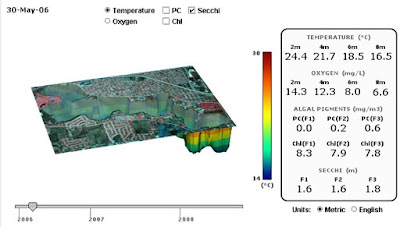
Try these interactive visualizations out for yourself by going to www.umich.edu/~hrstudy and clicking on 'Data Animation' or 'Historical Data Animation.'
Comments and feedback are greatly appreciated!
This visualization will allow community members to get a better understanding of what is happening inside Ford Lake and aid researchers like Dr. Lehman in finding patterns and relationships in the lake data.
From the site:
"This 3D visualization shows hourly lake data, updated on a regular basis, for wind speed and direction as well as temperature, oxygen, and turbulence at different depths. The information is combined with a 3D model of the lake bathymetry to produce an accurate view of spatial and temporal patterns."
Screenshot:

Another version of the application focuses on a historical data set spanning three years that includes additional data on algal pigments and water transparency.
Screenshot #2:

Try these interactive visualizations out for yourself by going to www.umich.edu/~hrstudy and clicking on 'Data Animation' or 'Historical Data Animation.'
Comments and feedback are greatly appreciated!
9/15/08
What is VR?
The big news of a couple days ago was the firing up of the Large Hadron Collider (or 'LHC') at CERN. This is awesome to us science-minded folks and should provided for some great advances in physics once they actually start smashing particles together.
But I digress. The actual reason a brought that up was a neat link that came up in my brief research on the subject. It's a set of 360 panoramic photos of the LHC by self-described 'VR Photographer' Peter McCready. An early Quicktime-based implementation of this technology was called QTVR and there is even an International Virtual Reality Photographers Association.
This technology and others like it are very cool, but should they really have the name 'VR' attached to them? Those of us who come from the world of interactive 3d graphics tend to say no, but it seems that the term has been diluted enough that the general public is accepting of all sorts of interpretations.
Sébastien "Cb" Kuntz at A VR Geek Blog has an interesting post on just this topic. He points out that the traditional understanding of what virtual reality is comes down to three things: realtime rendering, interaction, and immersion. Can a panoramic photograph really provide these things? Perhaps interaction (to a degree), but the others are surely not there...
Sébastien comes to the same conclusion that I did years ago when confronted with this same problem. We can't really hope to change the perceptions of the general public when it comes to these peripheral technologies, so we need to change our own vernacular to fit the bill. This why at N Formation Design we use terms like 'immersive', 'semi-immersive', and 'web-based' along with virtual reality to distinuish our own definitions of these technolgies.
Maybe photographer will start calling themselves Panoramic VR Photographers? Probably not :)
But I digress. The actual reason a brought that up was a neat link that came up in my brief research on the subject. It's a set of 360 panoramic photos of the LHC by self-described 'VR Photographer' Peter McCready. An early Quicktime-based implementation of this technology was called QTVR and there is even an International Virtual Reality Photographers Association.
This technology and others like it are very cool, but should they really have the name 'VR' attached to them? Those of us who come from the world of interactive 3d graphics tend to say no, but it seems that the term has been diluted enough that the general public is accepting of all sorts of interpretations.
Sébastien "Cb" Kuntz at A VR Geek Blog has an interesting post on just this topic. He points out that the traditional understanding of what virtual reality is comes down to three things: realtime rendering, interaction, and immersion. Can a panoramic photograph really provide these things? Perhaps interaction (to a degree), but the others are surely not there...
Sébastien comes to the same conclusion that I did years ago when confronted with this same problem. We can't really hope to change the perceptions of the general public when it comes to these peripheral technologies, so we need to change our own vernacular to fit the bill. This why at N Formation Design we use terms like 'immersive', 'semi-immersive', and 'web-based' along with virtual reality to distinuish our own definitions of these technolgies.
Maybe photographer will start calling themselves Panoramic VR Photographers? Probably not :)
9/12/08
Engaging User Experiences (Pt. 2)
In this Web 2.0 world, users are beginning to have an expectation of involvement in their web experiences. The second part of this article deals with possible ways to fill this need.
There are many techniques and technologies that can be used to create engaging user experiences. N Formation Design believes that the best and most promising solution is interactive (or "rich") media.
Interactive media includes all web applications with rich visual content and interactive capabilities that expand beyond the traditional scrolling, typing, and button-clicking.
Overcoming Stigma
Interactive media has been around for nearly as long as the web but has only recently become a reasonable option for the business community. Even so, it has yet to gain the critical mass needed to become a standard due to the strong stigma that lingers from past failures.
1. Download Times:
As stated in part one of this article, the average user will leave your site if the pageload time exceeds 8-10 seconds. The size of rich media applications made this standard nearly impossible to reach in the days of dial-up modems. Luckily broadband penetration has now reached 90.49% at home and 96.47% at work (June 2008), so this has more or less become a non-issue for most businesses' target audiences.
2. Plug-in Panic:
Most (if not all) interactive media applications require a browser plug-in to function. In the past, many web-users were understandably hesitant about downloading any unknown content, let alone installing applications that they may or may not know the function of.
These days, most interactive content is based on the Flash or Java platforms. A recent market study commissioned by Adobe showed that Flash and Java enjoy 99% and 85% coverage rates of Internet enabled desktops in mature markets. There seems to be no more justification for worrying about plug-in downloads, most users already have them installed! As a side note, these coverage rates fall to 45%-65% for video plug-ins - a technology that seems to have already become commonplace.
Virtual Tours
A great type of engaging user experience that incorporates interactive media is the virtual tour. Virtual tour probably brings to mind real estate - sets of pictures or 360 degree views of a location. This is one type of tour, but this concept can also be used for products, services, or even ideas.
The main idea is to let the user explore all of the parts, options, and nuances of product/service at their own pace. This allows them to get just the information they need without losing interest or attention. An example of this could be providing the user with an interactive 3D model of a product. This way the user can turn the product any direction to see the features that they are particularly interested in.
Configurators
Another engaging application is the configurator. This type of application allows users to configure a product or service specifically to their needs or to mix and match features and compare the results. To continue the product example used earlier, users might be given the option to pick a particular color or add-on and then view their own customized version in 3D.
Configurators also provide a marketing bonus in that they allow you to capture data on the most popular configurations and options. This data can then be used for production, print, or other marketing purposes.
Other Solutions
If you're still not sold on the powers of rich media, there are plenty of other options available that create engaging experiences. A couple of my favorites are user forums and user created content. They both allow users to 'belong' to an environment surrounding your product or topic. Forums allow for creation of community while user created content provides a sense of ownership with your site. A specific technique that has become more popular lately incentivizes contribution by holding contests for users to provide certain pieces of content.
The Bottom Line
We can remain passive no more! Businesses need to embrace the culture of interaction if they hope to engage potential customers and keep up with the pace of online competition. Interactive media provides the means and 'wow-factor' that is necessary to get the job done.
There are many techniques and technologies that can be used to create engaging user experiences. N Formation Design believes that the best and most promising solution is interactive (or "rich") media.
Interactive media includes all web applications with rich visual content and interactive capabilities that expand beyond the traditional scrolling, typing, and button-clicking.
Overcoming Stigma
Interactive media has been around for nearly as long as the web but has only recently become a reasonable option for the business community. Even so, it has yet to gain the critical mass needed to become a standard due to the strong stigma that lingers from past failures.
1. Download Times:
As stated in part one of this article, the average user will leave your site if the pageload time exceeds 8-10 seconds. The size of rich media applications made this standard nearly impossible to reach in the days of dial-up modems. Luckily broadband penetration has now reached 90.49% at home and 96.47% at work (June 2008), so this has more or less become a non-issue for most businesses' target audiences.
2. Plug-in Panic:
Most (if not all) interactive media applications require a browser plug-in to function. In the past, many web-users were understandably hesitant about downloading any unknown content, let alone installing applications that they may or may not know the function of.
These days, most interactive content is based on the Flash or Java platforms. A recent market study commissioned by Adobe showed that Flash and Java enjoy 99% and 85% coverage rates of Internet enabled desktops in mature markets. There seems to be no more justification for worrying about plug-in downloads, most users already have them installed! As a side note, these coverage rates fall to 45%-65% for video plug-ins - a technology that seems to have already become commonplace.
Virtual Tours
A great type of engaging user experience that incorporates interactive media is the virtual tour. Virtual tour probably brings to mind real estate - sets of pictures or 360 degree views of a location. This is one type of tour, but this concept can also be used for products, services, or even ideas.
The main idea is to let the user explore all of the parts, options, and nuances of product/service at their own pace. This allows them to get just the information they need without losing interest or attention. An example of this could be providing the user with an interactive 3D model of a product. This way the user can turn the product any direction to see the features that they are particularly interested in.
Configurators
Another engaging application is the configurator. This type of application allows users to configure a product or service specifically to their needs or to mix and match features and compare the results. To continue the product example used earlier, users might be given the option to pick a particular color or add-on and then view their own customized version in 3D.
Configurators also provide a marketing bonus in that they allow you to capture data on the most popular configurations and options. This data can then be used for production, print, or other marketing purposes.
Other Solutions
If you're still not sold on the powers of rich media, there are plenty of other options available that create engaging experiences. A couple of my favorites are user forums and user created content. They both allow users to 'belong' to an environment surrounding your product or topic. Forums allow for creation of community while user created content provides a sense of ownership with your site. A specific technique that has become more popular lately incentivizes contribution by holding contests for users to provide certain pieces of content.
The Bottom Line
We can remain passive no more! Businesses need to embrace the culture of interaction if they hope to engage potential customers and keep up with the pace of online competition. Interactive media provides the means and 'wow-factor' that is necessary to get the job done.
9/10/08
Engaging User Experiences (Pt. 1)
A couple of weeks ago I was invited to give a talk at a local marketing-focused lunch group. My topic was 'Engaging User Experiences' - what they are, and a few ideas on how to make them. It went over pretty well, so I thought I'd note some of the main points here.
Creating engaging user experiences is all about grabbing the user's attention and then keeping their interest. These are the common first steps to making a sale. Whether it's the sale of a product or the sale of an idea, they are still important.
Some basics:
Attention
Creating engaging user experiences is all about grabbing the user's attention and then keeping their interest. These are the common first steps to making a sale. Whether it's the sale of a product or the sale of an idea, they are still important.
Some basics:
Attention
- Avoid long page load times. Users will leave if the wait exceeds 8-10 seconds.
- Test, test, test and test some more with your target user group. This is the easiest way to find common annoyances and turn-offs.
- Eye tracking studies show that users will ignore anything that looks like a banner, whether it actually is or not ("Banner Blindness"). Keep this in mind when designing graphics.
- Provide users with "information scent", i.e. where should they click to get the information they are looking for. For instance, titling a link "Click here for more information!" provides very little information scent to the user. Something more specific, like "Click here for pricing details" will draw more clicks to the link and create a higher likelihood of customer satisfaction (or conversion) for that page content.
- Use appropriate levels of complexity. That is, simplify the user's experience at initial use (landing page) and then add and adapt at deeper engagement levels.
- Provide a user-driven experience. The easiest way to keep a user's interest is to let them decide what they want to see and when instead of inundating them with potentially useless or off-putting information.
8/21/08
Vivaty Update
I wanted to follow up on my last Vivaty post and mention that (as indicated by Pat at Vivaty) several improvements have been made in their latest release. There are now shared spaces that you can use as well as some gestures and other interactions. They even recently added virtual pets!
The most important release though is that of an authoring tool for scenes and objects. I have not tried it yet, but hope to soon. It looks like they have taken the appreciated route of using an external tool with a native .x3d format. This will make things highly portable and overall easier to create. (Are you following this SL? )
Another interesting note is that they are currently running a contest for developers with a top prize of $1000. I think it's a great way for them to promote the tool while also giving recognition to the talented modelers out there.
The most important release though is that of an authoring tool for scenes and objects. I have not tried it yet, but hope to soon. It looks like they have taken the appreciated route of using an external tool with a native .x3d format. This will make things highly portable and overall easier to create. (Are you following this SL? )
Another interesting note is that they are currently running a contest for developers with a top prize of $1000. I think it's a great way for them to promote the tool while also giving recognition to the talented modelers out there.
7/23/08
The Open Source Solution
 I've been getting a lot of questions about what the 'best' or 'easiest to learn' 3d modeling program is. After further discussion, it usually turns out that the person really wants to know what the 'cheapest' or 'easiest to obtain' program is. My answers to these people usually come in the form of some sort of open source solution. I've been really surprised at how few people actually know about these solutions or even the open source concept in general.
From the Open Source Initiative homepage: Open source is a development method for software that harnesses the power of distributed peer review and transparency of process. The promise of open source is better quality, higher reliability, more flexibility, lower cost, and an end to predatory vendor lock-in.
Open source allows users to contribute to the development process by writing, reviewing, and optimizing source code. Non-developer users can also contribute by providing bug reports, reviews, or financial support. Everyone gets the advantage of a freely available product that often has less bugs, is easier to use, and has more of a support community than its commercial rivals.
Following are some of my favorite open source solutions. Give them a try and remember to contribute where you can!
3d Modeling/Animation
Blender - Blender Tutorials
K-3D - K-3D Tutorials
Raster Image Creation/Editing
GIMP - GIMP Windows Installer
Vector Image Creation/Editing
Inkscape
Office Tasks (word processing, accounting, etc.)
OpenOffice
7/21/08
Emerging Tech: VideoTrace
Creating great looking real-time ready models of complex objects is getting easier and easier.
Anton van den Hengel of the Australian Centre for Visual Technologies is leading the development of an amazing new process that allows you to easily create 3d models from video. The process - called 'VideoTrace' - debuted last year at SIGGRAPH and involves interactively tracing the desired object over several frames of video.
Check out a very cool demo video here or here.
Image processing algorithms have existed for years that attempt to automatically detect and generate 3d meshes from a set of images. Examples of successful implementations are found in medicine and geology, where data sets involve known components with little variation. The limiting factor in taking this idea to general use has primarily been the ambiguities (jitter, fade, artifacts, etc.) of an undefined visual source.
VideoTrace compensates for these shortcomings by providing an interface for the user to interactively trace the desired object in the video. These tracings give hints to the algorithms about what should be processed and (theoretically) remove the major ambiguities. A paper describing the technology can be found here.
A note on the ACVT VideoTrace page says that they are currently looking for support for commercial development. I sure hope they get it. Even though models of some small objects would still be easier to generate with a low-end 3d scanner, the applications for this technology on a large scale are huge. Think of a bridge between Google Streetwise and Google Earth - users could quickly trace the video of all the houses on their block and have it uploaded for use in Google Earth.... The possibilities are many!
Anton van den Hengel of the Australian Centre for Visual Technologies is leading the development of an amazing new process that allows you to easily create 3d models from video. The process - called 'VideoTrace' - debuted last year at SIGGRAPH and involves interactively tracing the desired object over several frames of video.
Check out a very cool demo video here or here.
Image processing algorithms have existed for years that attempt to automatically detect and generate 3d meshes from a set of images. Examples of successful implementations are found in medicine and geology, where data sets involve known components with little variation. The limiting factor in taking this idea to general use has primarily been the ambiguities (jitter, fade, artifacts, etc.) of an undefined visual source.
VideoTrace compensates for these shortcomings by providing an interface for the user to interactively trace the desired object in the video. These tracings give hints to the algorithms about what should be processed and (theoretically) remove the major ambiguities. A paper describing the technology can be found here.
A note on the ACVT VideoTrace page says that they are currently looking for support for commercial development. I sure hope they get it. Even though models of some small objects would still be easier to generate with a low-end 3d scanner, the applications for this technology on a large scale are huge. Think of a bridge between Google Streetwise and Google Earth - users could quickly trace the video of all the houses on their block and have it uploaded for use in Google Earth.... The possibilities are many!
7/15/08
ReViving Virtual Worlds pt. 2
 After yesterday's foray into the Lively beta, I finally decided to swing back to the Vivaty private beta invite that had been sitting neglected in my inbox. To my surprise, they are now supporting IE6 as well as IE7. So, though I'd really like to see Firefox capabilities, at least I didn't have to upgrade...
Vivaty currently functions as a Facebook or AIM imbedded application. I decided to go the Facebook route. This integration ended up being great - at least on the setup side of things. The usual Facebook login also served as the Vivaty login, transferring all of my Facebook data to the application as well. This was great, as it provided for a quick entry into the app and my default scene already had some personal touches (profile pics, info, etc.).
The application loaded fairly quickly (< 1 minute) and had a graphical quality similar to SecondLife. The navigation was also reminiscent of SL, but without a 'fly' option and a little clunkier and less responsive. A small menu allows you to add to your scene from a library of pre-made objects. You can modify their size and texture, but that's about it. Avatar customization is also limited to selection from a library.
I found Vivaty to be very functional (with a few glitches - to be expected in a beta) and on par visually with the competition, but incredibly lonely! A shared virtual environment quickly loses it's appeal if there is no one to share it with. Instead of adopting a 'public spaces' policy like Lively or SL, Vivaty opts for a private 'invite-only' system. The only way to share your space with others, or visit someone else, is to invite people from your Facebook or AIM friend lists.
Ingenious marketing strategy or fatal flaw? It's a great idea to tap into a well established distribution network, but I think Vivaty is making a mistake by not facilitating some sort of public meeting spaces. I'm sure this makes the system easier to manage, but it also stops the flow of users who just want to try out the experience without getting to invested or subjecting their friends to unwanted invites.
In the end, I think the lack of social spaces puts the Vivaty beta a step below Lively. While Lively definitely needed some technical issues worked out, the experience was still engaging and available. Vivaty was interesting at first, but quickly became old without true object creation options or interaction. Perhaps the public release will open things up. If so, I will gladly add Vivaty to my regular list of virtual hangouts!
Subscribe to:
Posts (Atom)


