The Bureau of Surveying and mapping in China has announced that they are nearly finished measuring and digitizing the last surviving portions of the Great Wall. The digital models are being created from detailed photographic mappings of nine provinces in the northern region of the country.
Furthermore, the traditionally Internet-unfriendly Chinese government will make the models available online.
This is a great example of the preservation benefits of 3D digitizing and modeling. Even though the wall is significantly degraded, future generations will be able to view and reproduce this "Wonder of the World" as it stands at this time.
Maybe Google can convince them to allow the inclusion of these models into their recent efforts to catalog history?

1/14/09
Project Launch: 3D Pendant Configurator

We are happy to announce the successful launch of our latest interactive web project, a 3d configurator and sales application for custom made pendants. Commisioned by Austin & Warburton Jewelers of Ann Arbor, MI, the application was launched at TheParentAndChild.com shortly before the busy holiday shopping season.
From the project page:
We designed a set of customized 3d configurators that independently focused on each of the detailed and unique pendants. Users can load one of the three pieces and configure it to their own specifications. Choices include pendant size and several metal types and colors. A wide cariety of gemstones can also be selected and placed in specific locations. Each configuration choice is updated instantly on the 3d model without a page reload.The application was fully integrated with the client's existing shopping cart system and provided a significant upgrade from their previous set of static 2D images. The previous month of heavy use has shown the application to be a great success as described in the message below from Craig Warburton, owner and manager of Austin & Warburton Jewelry:
"It is difficult to describe just how much the product configurator has meant to our online business. Cart abandonment has dropped by 50%, returns for selecting undersized birthstones has all but disappeared and sales have grown 50% faster than I ever imagined possible. The 3D format allows the user to see just how thick and heavy the item is, removing the "cheap and flimsy" fear so much online jewelry formats invoke. The service we received was world class in scope, depth and timing. The seamless integration into our shopping cart software is amazing. In one keystroke, the user can place as many as 10 items into the cart, and we gained control otherwise only provided by written warnings when you established "rules" for application of stone sizes and locations. I always felt our website was superior to many others in our product field, but the configurator you created is the new engine of sales and unmatched by anything in the marketplace. I will call on N Formation Design again and again. The value provided far exceeded my every expectation."
1/13/09
Googling the Future
For a great example of the benefits of 3d and virtual environments, take a look at the new addition to Google Earth recently reported in an article by a Bay Area ABC affiliate.
Google Earth has become a great tool for interactively viewing existing structures and topology, but the truly novel step comes in integrating future structures with the existing world. Google has done just that by adding models (provided by Caltrans) of the yet-to-be-completed Bay Bridge over the existing virtual San Francisco Bay.
From the article:
I hope this is not just an idle PR statement. Google Earth over time (Google History?) would be an amazing and unprecedented educational tool. The amount of data that could be incorporated is almost unfathomable. The movement of land masses, industrialization, perhaps even battle re-enactments. If anybody can do it, I believe it will be these guys. Fingers crossed!
Google Earth has become a great tool for interactively viewing existing structures and topology, but the truly novel step comes in integrating future structures with the existing world. Google has done just that by adding models (provided by Caltrans) of the yet-to-be-completed Bay Bridge over the existing virtual San Francisco Bay.
From the article:
Until now, Google Earth had a policy of showing only completed structures, for an accurate picture of the earth. But along with adding 3D images, Google has decided to go into the fourth dimension -- time. The bridge is the future, Ancient Rome is in the past.
"I would like to do more of the past, more of the future, to make Google Earth not just everywhere, but every when. A time travel machine for people to understand their heritage, and their future," said [Google CTO Michael] Jones.
I hope this is not just an idle PR statement. Google Earth over time (Google History?) would be an amazing and unprecedented educational tool. The amount of data that could be incorporated is almost unfathomable. The movement of land masses, industrialization, perhaps even battle re-enactments. If anybody can do it, I believe it will be these guys. Fingers crossed!
1/8/09
Desktop 3D Scanning
The RealView 3D company has announced a new desktop 3D scanner that will be unveiled at the recently opened CES 2009. It's great to see more competition in this market. Hopefully the prices of these systems will begin to come down! NextEngine seems to have the most popular 'low cost' version which still comes in at $2995 for the bare-bones package. Though we don't have one in house, I have seen demos of the NextEngine system and the quality is very good for the price. Unfortunately, there doesn't seem to be any price or quality info currently available for the RealView scanner. It will be interesting to compare the too once more details are released. A recent Wired article is already predicting a loss for RealView...
In the meantime, why not try out a do-it-yourself solution! The DAVID scanner requires only a handheld laser ( < $30 USD), a webcam (< $50 USD), and a license for the DAVID-laserscanner software (trial version - FREE, pro version, ~$275 USD). There are some demos and production videos on the site that are definitely worth checking out. Pretty amazing for the investment! If this sort of project is up your alley, why not add on a DIY 3D printer for a full-blown homemade prduction pipeline!
Though all this solutions will inevitably require some patching and smoothing by a 3D artist for production quality models, the increasing availability and accessibility of these machines will no doubt decrease the workload for developers and allow us to produce high-quality content faster and more cost-effectively.
In the meantime, why not try out a do-it-yourself solution! The DAVID scanner requires only a handheld laser ( < $30 USD), a webcam (< $50 USD), and a license for the DAVID-laserscanner software (trial version - FREE, pro version, ~$275 USD). There are some demos and production videos on the site that are definitely worth checking out. Pretty amazing for the investment! If this sort of project is up your alley, why not add on a DIY 3D printer for a full-blown homemade prduction pipeline!
Though all this solutions will inevitably require some patching and smoothing by a 3D artist for production quality models, the increasing availability and accessibility of these machines will no doubt decrease the workload for developers and allow us to produce high-quality content faster and more cost-effectively.
1/6/09
3D Nature! - Interactive Vizualization Hits the Big Time
Nature, the preeminent journal of scientific research, has boosted the credibility of interactive 3d for scientific visualization by publishing their first 3d interactive figure. The January 1st issue contains 3d figures of molecular clouds in a paper first-authored by Alyssa A. Goodman, astronomy professor at Harvard University.
Nature makes use of '3d PDF' technology which allows 3d applets to be embedded in PDF document pages, much like we currently embed them in traditional web pages. Try out the published models (and others) for yourself at this page on the site of Goodman's Initiative in Innovative Computing group. Note: You'll need Adobe Reader 8.1.2 or better to view and interact with the 3d modules.
Screenshot:

We won't pretend to comprehend exactly what is going on in this figure, but one thing we do know is 3d - and the fidelity of this model is fantastic. There a few awkward interaction elements that could be smoothed out, but nothing due to limitations of the technology. The most exciting about this publication for us is that the backing of Nature is sure to increase the exposure and enthusiasm for interactive 3d technologies. Many fields that already make use of 3d technologies to visualize data in their labs will greatly benefit from this expanded ability to communicate their findings to readers.
Anyone interested in using 3d PDF technology for their own work should contact us for more detail.
Nature makes use of '3d PDF' technology which allows 3d applets to be embedded in PDF document pages, much like we currently embed them in traditional web pages. Try out the published models (and others) for yourself at this page on the site of Goodman's Initiative in Innovative Computing group. Note: You'll need Adobe Reader 8.1.2 or better to view and interact with the 3d modules.
Screenshot:

We won't pretend to comprehend exactly what is going on in this figure, but one thing we do know is 3d - and the fidelity of this model is fantastic. There a few awkward interaction elements that could be smoothed out, but nothing due to limitations of the technology. The most exciting about this publication for us is that the backing of Nature is sure to increase the exposure and enthusiasm for interactive 3d technologies. Many fields that already make use of 3d technologies to visualize data in their labs will greatly benefit from this expanded ability to communicate their findings to readers.
Anyone interested in using 3d PDF technology for their own work should contact us for more detail.
1/5/09
3D Arlington - Leading the Way
A recent article in the Washington Post highlights efforts by Arlington County government to bring the region into the flourishing world of interactive 3d. Resident John Feather is volunteering his time to get these advanced technology initiatives off the ground and making sure they get the attention they deserve.
Much of the article is devoted to area presences in Second Life. Feather (avatar name: Theatre Magic) leads reporters and other interested parties on guided tours of some of these spaces, making sure to show the power and flexibility of the environment:
We need more people like John! It's great to see people in previously untapped areas of life getting the interest and enthusiasm for interactive 3d that us pros have been shouting about for years. I found the following note most interesting:
This sounds like a great idea that even non-techies can see the benefit of. Incorporating spatial data (buildings and locations) with other info (rent data, etc.) will allow people to explore data in a new and relevant way while helping them to answer important questions (where should I live?).
Keep it up John! We applaud your enthusiasm and hope that it inspires others. Let us know if there is anything we can do to help!
Much of the article is devoted to area presences in Second Life. Feather (avatar name: Theatre Magic) leads reporters and other interested parties on guided tours of some of these spaces, making sure to show the power and flexibility of the environment:
One recent evening, Theatre was shepherding a reporter toward the county's online office space for a tour when he sent a text message suggesting a detour. "Want to go swimming?" he wrote. He then teleported to a lake surrounded by Japanese maples and did a summersault from a cliff with an animated Buddha nearby. It was a long way from the Arlington office, but what better place to ponder the future of government?
We need more people like John! It's great to see people in previously untapped areas of life getting the interest and enthusiasm for interactive 3d that us pros have been shouting about for years. I found the following note most interesting:
In November, he started working on a 3D map of Arlington's major buildings. Touching images on the map calls up Web pages about them, and he and his colleagues want to add real-time rent data and detailed visuals from architects and developers so that "when you click on that building, you go in the door."
This sounds like a great idea that even non-techies can see the benefit of. Incorporating spatial data (buildings and locations) with other info (rent data, etc.) will allow people to explore data in a new and relevant way while helping them to answer important questions (where should I live?).
Keep it up John! We applaud your enthusiasm and hope that it inspires others. Let us know if there is anything we can do to help!
1/2/09
Ringing in the New Year
N Formation Design had a great 2008 with many exciting interactive 3d projects. We look forward to new adventures in the coming year and hope for continued adoption of interactive 3d technologies.
Stay tuned to the N Formation Design Blog for more (and hopefully more frequent!) news, tips, and technology reviews in the coming year.
Happy New Year and best wishes for business in 2009!
Stay tuned to the N Formation Design Blog for more (and hopefully more frequent!) news, tips, and technology reviews in the coming year.
Happy New Year and best wishes for business in 2009!
10/13/08
EmergingTech: ILoveSketch
ILoveSketch is a very cool application recently announced by the Dynamic Graphics Project (DGP) lab at the University of Toronto. In short, it makes sketching in 3D as intuitive as I have ever seen it. Anyone who has ever tried 3D modeling, especially an organic object, knows that the process is far from straight-forward. Sketches are usually used only as 2d reference points that have to be viewed in a single viewport.
Though ILoveSketch doesn't translate sketches directly into models, it's easy to see how helpful it could be in the process. And who knows, maybe the DGP will use this great app as a starting point for something bigger? Take a look at a video of the software in use and see for yourself!
From the site - ILoveSketch is:
"A 3D curve sketching system that captures some of the affordances of pen and paper for professional designers, allowing them to iterate directly on concept 3D curve models. The system coherently integrates existing techniques of sketch-based interaction with a number of novel and enhanced features. Novel contributions of the system include automatic view rotation to improve curve sketchability, an axis widget for sketch surface selection, and implicitly inferred changes between sketching techniques. We also improve on a number of existing ideas such as a virtual sketchbook, simplified 2D and 3D view navigation, multi-stroke NURBS curve creation, and a cohesive gesture vocabulary."
Though ILoveSketch doesn't translate sketches directly into models, it's easy to see how helpful it could be in the process. And who knows, maybe the DGP will use this great app as a starting point for something bigger? Take a look at a video of the software in use and see for yourself!
From the site - ILoveSketch is:
"A 3D curve sketching system that captures some of the affordances of pen and paper for professional designers, allowing them to iterate directly on concept 3D curve models. The system coherently integrates existing techniques of sketch-based interaction with a number of novel and enhanced features. Novel contributions of the system include automatic view rotation to improve curve sketchability, an axis widget for sketch surface selection, and implicitly inferred changes between sketching techniques. We also improve on a number of existing ideas such as a virtual sketchbook, simplified 2D and 3D view navigation, multi-stroke NURBS curve creation, and a cohesive gesture vocabulary."
9/24/08
Review: ExitReality
I recently came across another newcomer to the web-based virtual worlds market: ExitReality.
At face value, ExitReality functions similarly to all of the others out there (SL, Vivaty, Lively, IMVU, etc.). You register (free), login, and get a customizable avatar dropped into a social 'lounge' area where other users also congregate. When I first tried the Beta environment out, there were about 10 other users. Pretty small, but they seem to be fairly new and still growing.
 The unique thing about ExitReality is that it is based around the idea of navigating an actual 3d web. It's a concept that has been tried many times before, but never really caught on. In the 'ExitReality Plaza' the commercial aspects of this are pretty in your face. Each major building or structure in the environment is associated with some sort of business interest. There's a Carl's Jr, Wall Street Journal, and ESPN buildings, a Match.com ice cream truck (?) and many others. And as far as I can tell, these commercial interests are all just facades. I would expect to be able to go into the buildings and find related content, but the only further action is to click on their signs and be taken to their regular 2d site.
It's an interesting idea, but I still don't see it gaining mass market appeal. So far, it seems to just be a 3d chat with a whole lot of advertisements. There's just not a whole lot to do. The one advantage this site has over others is load time. It was definitely quicker than the others I've reviewed, but other important aspects - navigation, visual quality, content - all seemed to be lacking. If they mature in at least one of these areas, I'd consider them a contender due to their novelty but right now, they have a ways to go.
 The other interesting aspect of this site is their claim to 'View any website in 3d'. I tried our site and got a pretty sad result. The algorithm they are using seems to just grab the graphics from your screen and paste them on various objects in an environment. They also seem to incorporate the site color scheme into the overall asthetic. The '3d' nformationdesign.com turned out to be one big wall with a screen shot of the homepage and then a 'field' of linked graphics that looked like flags on poles. It was pretty disappointing. I think this 'view any page in 3d' concept is probably their best selling point, but the algorithm needs some major improvements. Maybe some simple image processing to guess at what some of the pictures are, so they can be turned into actual 3d representations? How about doors or passages to take you to other rooms (pages) of the site instead of these link 'flags'? There are a lot of options here.
I'm glad to see more businesses take a stab at this sort of thing, but I think the market is getting to the point where the application needs to be a little more mature to catch on.

Did I miss something? Let me know.
At face value, ExitReality functions similarly to all of the others out there (SL, Vivaty, Lively, IMVU, etc.). You register (free), login, and get a customizable avatar dropped into a social 'lounge' area where other users also congregate. When I first tried the Beta environment out, there were about 10 other users. Pretty small, but they seem to be fairly new and still growing.
 The unique thing about ExitReality is that it is based around the idea of navigating an actual 3d web. It's a concept that has been tried many times before, but never really caught on. In the 'ExitReality Plaza' the commercial aspects of this are pretty in your face. Each major building or structure in the environment is associated with some sort of business interest. There's a Carl's Jr, Wall Street Journal, and ESPN buildings, a Match.com ice cream truck (?) and many others. And as far as I can tell, these commercial interests are all just facades. I would expect to be able to go into the buildings and find related content, but the only further action is to click on their signs and be taken to their regular 2d site.
It's an interesting idea, but I still don't see it gaining mass market appeal. So far, it seems to just be a 3d chat with a whole lot of advertisements. There's just not a whole lot to do. The one advantage this site has over others is load time. It was definitely quicker than the others I've reviewed, but other important aspects - navigation, visual quality, content - all seemed to be lacking. If they mature in at least one of these areas, I'd consider them a contender due to their novelty but right now, they have a ways to go.
 The other interesting aspect of this site is their claim to 'View any website in 3d'. I tried our site and got a pretty sad result. The algorithm they are using seems to just grab the graphics from your screen and paste them on various objects in an environment. They also seem to incorporate the site color scheme into the overall asthetic. The '3d' nformationdesign.com turned out to be one big wall with a screen shot of the homepage and then a 'field' of linked graphics that looked like flags on poles. It was pretty disappointing. I think this 'view any page in 3d' concept is probably their best selling point, but the algorithm needs some major improvements. Maybe some simple image processing to guess at what some of the pictures are, so they can be turned into actual 3d representations? How about doors or passages to take you to other rooms (pages) of the site instead of these link 'flags'? There are a lot of options here.
I'm glad to see more businesses take a stab at this sort of thing, but I think the market is getting to the point where the application needs to be a little more mature to catch on.

Did I miss something? Let me know.
9/16/08
Ford Lake Data Visualization
N Formation Design is happy to announce the completion of a great 3D data visualization in cooperation with Dr. John Lehman of the University of Michigan. This project incorporates spatial data gathered by Dr. Lehman via sensors in Ford Lake (Ypsilanti Twp, MI) with a 3D model of the actual bathymetry (underwater shape) of the lake.
This visualization will allow community members to get a better understanding of what is happening inside Ford Lake and aid researchers like Dr. Lehman in finding patterns and relationships in the lake data.
From the site:
"This 3D visualization shows hourly lake data, updated on a regular basis, for wind speed and direction as well as temperature, oxygen, and turbulence at different depths. The information is combined with a 3D model of the lake bathymetry to produce an accurate view of spatial and temporal patterns."
Screenshot:

Another version of the application focuses on a historical data set spanning three years that includes additional data on algal pigments and water transparency.
Screenshot #2:
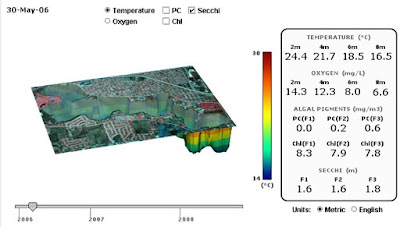
Try these interactive visualizations out for yourself by going to www.umich.edu/~hrstudy and clicking on 'Data Animation' or 'Historical Data Animation.'
Comments and feedback are greatly appreciated!
This visualization will allow community members to get a better understanding of what is happening inside Ford Lake and aid researchers like Dr. Lehman in finding patterns and relationships in the lake data.
From the site:
"This 3D visualization shows hourly lake data, updated on a regular basis, for wind speed and direction as well as temperature, oxygen, and turbulence at different depths. The information is combined with a 3D model of the lake bathymetry to produce an accurate view of spatial and temporal patterns."
Screenshot:

Another version of the application focuses on a historical data set spanning three years that includes additional data on algal pigments and water transparency.
Screenshot #2:

Try these interactive visualizations out for yourself by going to www.umich.edu/~hrstudy and clicking on 'Data Animation' or 'Historical Data Animation.'
Comments and feedback are greatly appreciated!
Subscribe to:
Posts (Atom)

